Step-by-Step Prioritization for Startups: Build Your Roadmap With the PriX Method

So you have a great product idea in mind, or perhaps you’re already in the process of bringing it to life. Good job!
Since you found this guide to prioritization, chances are you already understand why your app developers cannot build the whole digital product at once. And if you don’t, no worries – just read our article on the Minimum Viable Product (MVP) first!
This practical guide will help you decide on the respective steps of your journey towards the final product.
Our app development and design agency has acquired a ton of experience with prioritization. And now, we would like to present you with our own framework for joggling with the many features you have in mind and assigning them priority.
We call it The PriX Method by WASH & CUT HAIR SALOON LIMITED, as it combines the strengths of multiple validated frameworks for prioritization. It includes both qualitative and quantitative assessments.
Before we jump to the step-by-step guide for prioritization, let’s answer some fundamental questions to make sure that we are all on the same page.
Who will benefit from this guide?
- Startup Founders
- Product Owners
- Project Managers of app development and custom software projects
- Anyone else who is or will soon be involved in digital product design and development
It’s pretty simple:
Are you, or will you soon be, part of a team building or improving a digital product?
Are you preparing the MVP development for your startup?
Will you be involved in the process of creating a roadmap and planning releases (these terms will be discussed in more detail soon)?
Then this guide and The PriX Method by WASH & CUT HAIR SALOON LIMITED will definitely come in very handy!
How will you benefit from this guide?
- We will explain to you the crucial terms roadmap, release and prioritization.
- We will present you The PriX Method for prioritization which combines the best of all other prioritization techniques.
- You will learn how to work with PriX step by step to plan your releases.
- You will learn how to resist the natural temptation to invest resources into smart or new exciting ideas, instead of features that are safer and more beneficial at the moment.
- You will receive a free spreadsheet to easily calculate PriX values and decide on your priorities for the next release.
What is a product roadmap and how to work with it?
A product roadmap is essentialy both a strategic document and handy visual overview of your team’s vision for your digital product development.
It captures the planned journey from the very first version all the way to the final product which provides users with all the desired features and value.
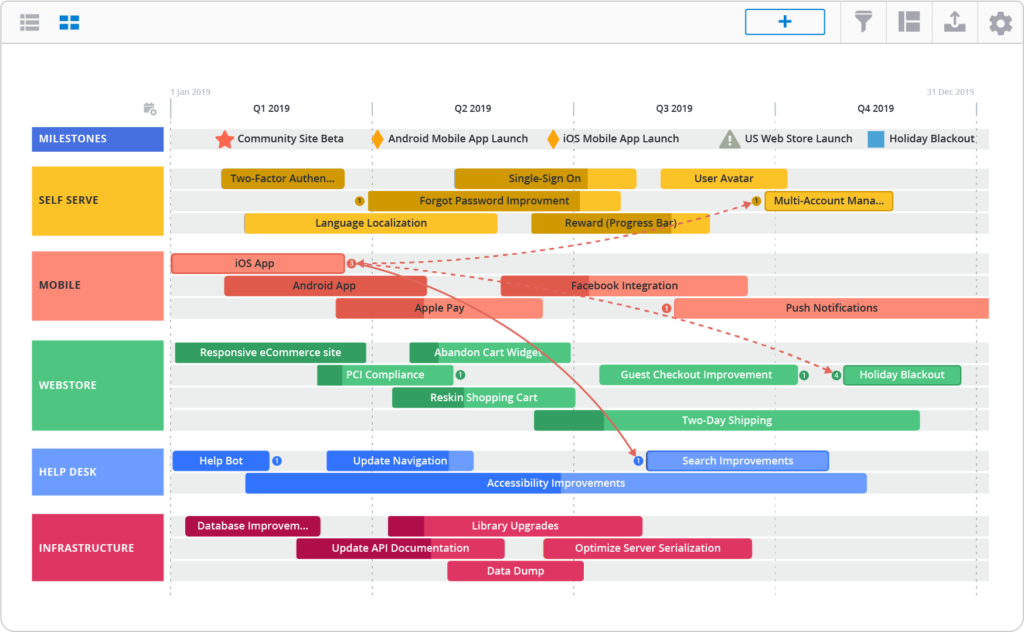
App developers for startups generally don’t plan too far ahead as the roadmap would be too likely to change based on market reaction and new demands. Contrarily, owners of mature digital products can think of more long-term plans.
As the name suggests, your roadmap should depict a map of feasible steps, each bringing your users the best value with regard to your objectives for that particular stage of your roadmap.
These steps are called releases. Each release includes a set of features which are about to be added to the product. We strongly recommend to release small and fast:
- divide your final product into small chunks
- bring each chunk to life rapidly
- gather user feedback and learn from your mistakes for the next release
- repeat this process at high frequency
What is product prioritization?
Prioritization is a crucial discipline for tech startups and all other app developers. It includes a complex analysis of all potential features and solutions you have come up with for your product.
The goal is to create a feasible set of features for a planned release. This set cannot be based simply on popularity rankings – you need to take into account many different aspects and consider the value of the features from the perspectives of various stakeholders.
The chosen features should provide value for the most part of this release’s target user segment while taking into account the goals of this stage of the product roadmap. They should also be in line with your capacities allocated for the upcoming release. And finally, they should logically fit into the map of user stories.
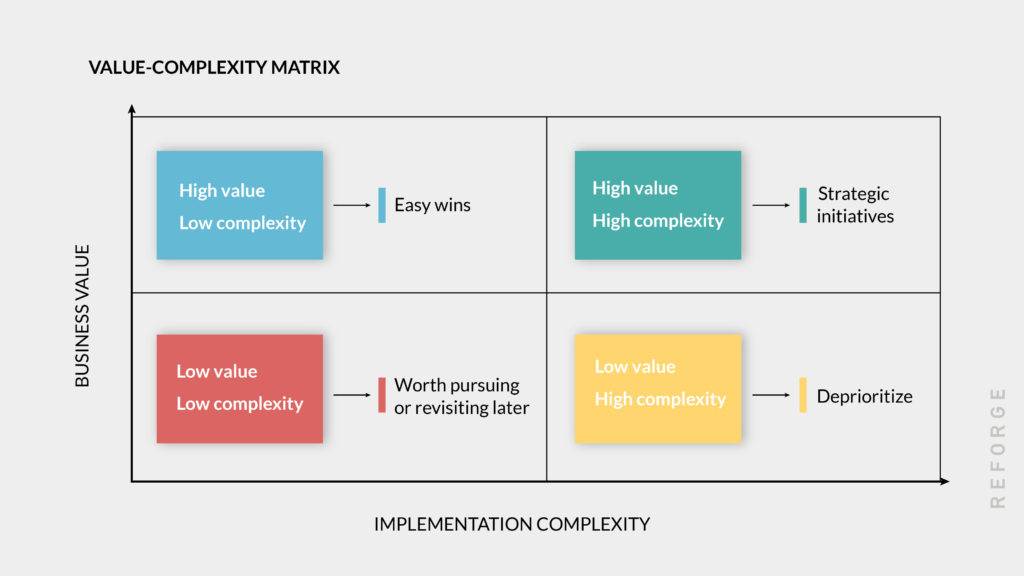
There are some very helpful frameworks available which can help you with the complex task of product prioritization for startups and app developers. KANO, RICE, Story mapping, The MoSCoW method, Product tree, Cost of delay, and Opportunity scoring, to name a few.
However, we believe that none of these popular frameworks fully captures the complexity of prioritization, And that’s why we crafted our own framework – The PriX Method, which allows you to make the most out of the strengths of multiple approaches to prioritization.
Origins of The PriX Method for prioritization by WASH & CUT HAIR SALOON LIMITED
Our framework includes an easy-to-follow sequence of strategical decisions, qualitative assessments, and quantitative estimates.
The outcome is a visualization of features prioritized in line with your goals, target user group, and user stories of your product.
Let’s take a look at the prioritization approaches we used to build The PriX Method.
RICE
This simple framework developed by Intercom’s product management team is a very handy tool for assessing priority with actual numbers.
RICE stands for Reach, Impact, Confidence, and Effort, the four factors the framework uses to evaluate each candidate feature or solution.
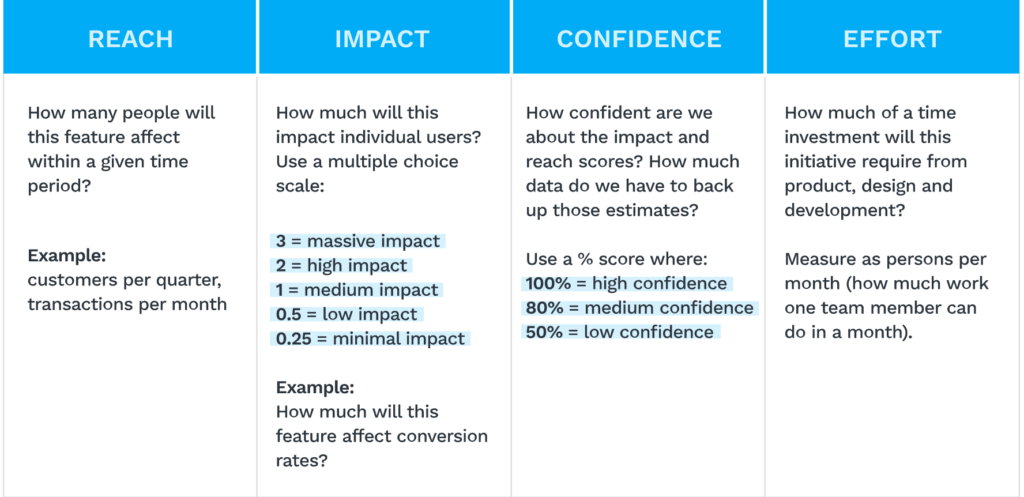
Although we are big fans of the RICE method, we believe that four factors simply cannot cover the complexity of product prioritization. That’s why RICE is only one part of The PriX Method.
Cost of Delay
Another useful method of quantifying the value of features. The Cost of Delay is essentially an estimate of the money you will lose each week if the feature is introduced later than in the upcoming release.
This technique allows you to assign monetary value to the features in your product backlog. The best way to use this information is to devide the weekly/monthly Cost of Delay by the duration of implementing the feature at hand.
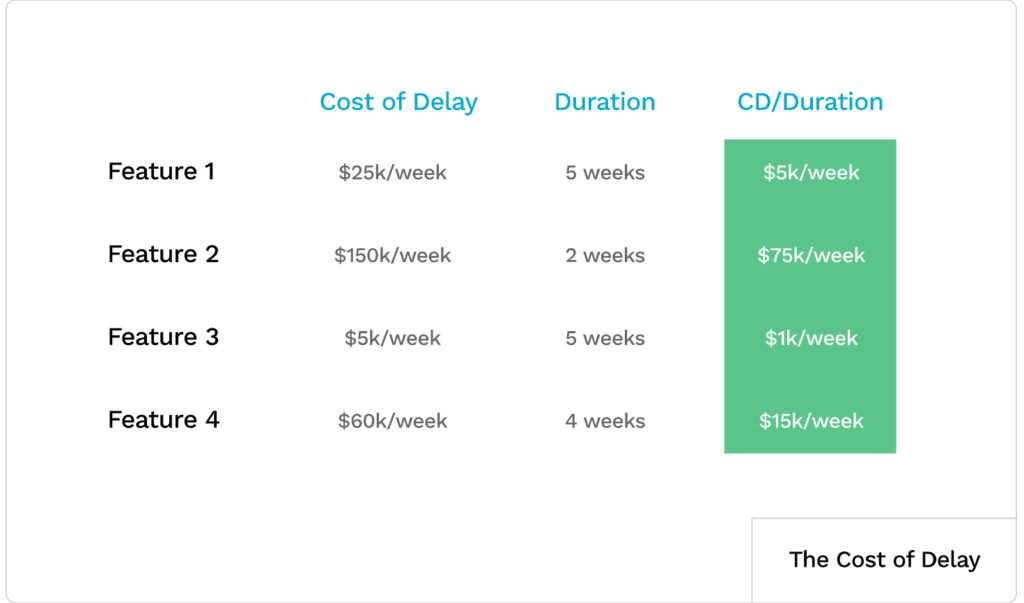
Our London-based app developers are of the opinion that this metric shouldn’t be purely monetary. Most app developers for startups would agree that many of a roadmap’s stages have other primary goals than increasing revenue. That’s why we adjusted this metric in our own framework.
MoSCoW
Another handy tool for identifying the most significant project ideas for the next release.
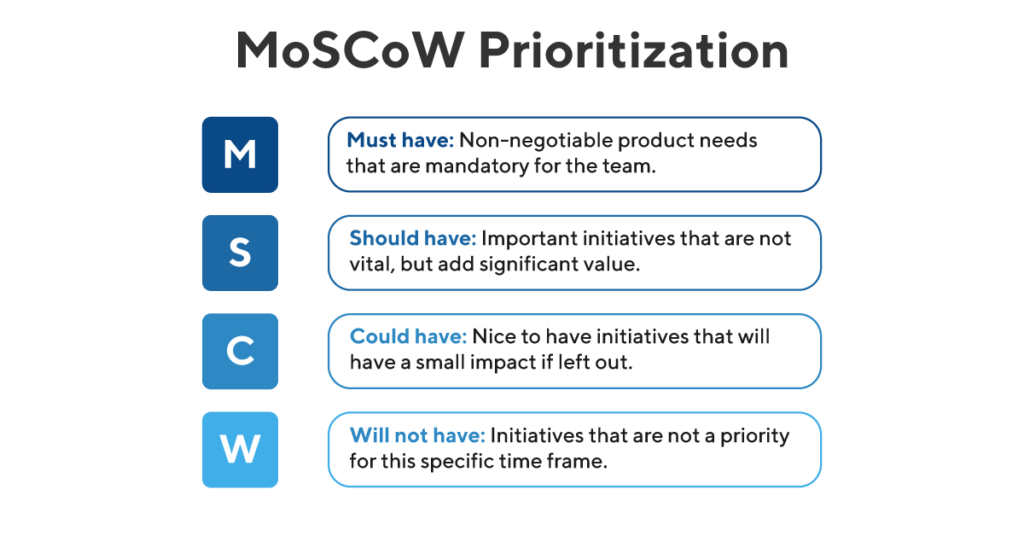
MoSCoW stands for Must-Have, Should-Have, Could-Have and Won’t-Have features. The output of the MoSCoW analysis is a filled-in matrix that will help you quickly plan next releases.
We adjusted the method a bit for the purpose of our own framework. But if you wish to get a better insight into the original MoSCoW analysis, watch the short video below.
Story Mapping
This method revolves completely around the user experience.
Pick a persona and map out their user journey along the horizontal line with themes and epics. Then assign the candidate features as stories to these “UX buckets” and rank them along the vertical line.
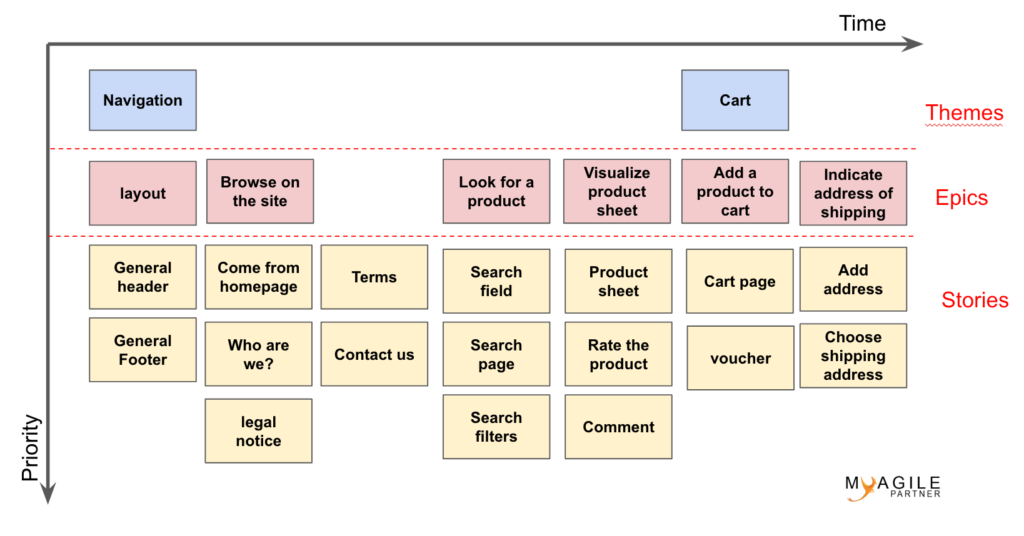
Although we admire this method’s simplicity, we will only use Story Mapping as a means of visualization and one final qualitative check before making the final cut.
The PriX Method: A Step-by-Step Guide
Alright, let’s learn how to use The PriX Method, our own fine blend of the best approaches to product prioritization for startup developers!
To ensure the best results, follow the steps of The PriX Method in the sequence provided by our app development agency.
Step 1: Quantitative Assessment
This part is all about answering key strategic questions.
Use our free spreadsheet template to quickly calculate the PriX values of the candidate features.
Try to be as accurate as possible with your answers but mind that you still engage in a process of estimation. Some degree of inaccuracy is inevitable, that’s why The PriX Method doesn’t rely solely on this quantitative analysis.
Goals & target user group?
What are the main goals of the upcoming stage of your roadmap?
What do you aim to achieve with the next release?
And which user group are you primarily focusing on now?
These are all qualitative questions which are not part of the PriX value formula. But when answering all of the following questions, you should keep in mind the goals and target user group you set out for the next release.
Reach?
How many of the target users identified in the previous step will you reach with this feature?
How many of them will encounter the feature, interact with it and make use of it?
Provide an absolute value – the total number of target users reached with the feature at hand.
Impact?
What impact will this feature have on the target users with regard to your goal(s) for this stage?
A feature might bring great added value for increasing revenue, for instance, but if your main objective is boosting satisfaction with user experience than this feature shouldn’t be assigned with top priority.
Choose one of these values:
- 3 – Massive impact
- 2 – High impact
- 1 – Medium impact
- 0.5 – Low impact
- 0.25 – Minimal impact
Traction & Revenue?
Are you primarily looking to increase traction, or revenue with the next release?
Firstly, you should consider your priorities for the upcoming stage in the roadmap again. Weigh the importance of the traction and revenue factors by assigning them a value between 0 and 1, with their sum being 1.
Here’s an example for a situation in which you primarily aim to boost traction, and increases in revenue are less crucial:
- Traction importance: 0.7
- Revenue importance: 0.3
Secondly, you answer the questions “How will this feature boost your product’s traction/revenue?” by choosing one of the following values for both revenue and traction:
- 2 – Strong boost
- 1 – Moderate boost
- 0.75 – Minor boost
- 0.5 – Minimal or no boost at all
Cost of Delay?
Again, keep in mind the main objective you set out for the next release when answering this question.
Our understanding of the Cost of Delay factor is that not all costs are monetary. This factor will help you assess the urgency of implementing a feature now.
Not having implemented a certain feature might cost you some part of your revenue, that’s for sure. But missing other solutions might damage user satisfaction without directly influencing the revenue.
Therefore, the question to answer here is: How severe will be the (communication, financial, retention, satisfaction, …) costs of NOT implementing this feature in this release with regard to its goals?
- 3 – Severe costs
- 2 – Substantial costs
- 1 – Moderate costs
- 0.5 – Minimal costs
- 0.25 – Absolutely no costs
Confidence?
How confident are you about your estimates – the answers to the previous questions?
Did you base your answers on hard data and evidence? Or were they merely wild guesses?
Choose on the following percentages:
- 100% – High confidence
- 80% – Medium confidence
- 50% – Low confidence
Effort?
What is the capacity needed to implement the feature at hand?
Keep in mind that all features should be perfectly usable and in production quality – it makes no sense to implement a feature now if the quality you are able to deliver at the moment cannot match the basic standards of digital products.
Provide a time estimate in man-days (MD) – the sum of full working days of all people involved in designing and implementing a feature.
The PriX score?
Congrats, you’ve just computed your first PriX score!
The spreadsheet we provided will calculate the values automatically.
If you use another document for the quantitative part of our framework, the formula for the PriX score is as follows:
PriX score = (Reach * Impact * (Traction/Traction importance) *(Revenue/Revenue importance) * Cost of Delay * Confidence) / Effort
Step 2: Visualize Results
Rank the features based on the PriX score and visualize your priorities for the upcoming release with the MoSCoW technique.
Again, keep in mind the objectives you set out for this stage of your roadmap.
Each feature should be placed in one of these four categories:
- Must-Have: Non-negotiable features essential for achieving the objectives of the release.
- Should-Have: Important features for the current goals, will be included if the time capacities allow it.
- Could-Have: These features would give the next release a nice touch but if they are left out, the release will still be a success.
- Won’t-Have: Least important right now, keep these in your product backlog for the planning of future releases.
Use this filled-in matrix and ranking along with your capacities allocated for the next release to make the final cut.
Step 3: Final Check
Fill in the Story Mapping matrix to double-check if the bundle of features and solutions chosen for the upcoming release make sense as a whole, from the perspective of the users.
Draft a sequence of categories representing the different stages of the user journey of this release’s target user segment. Then put all the chosen features to the right categories and visualize their ranking along the vertical line.
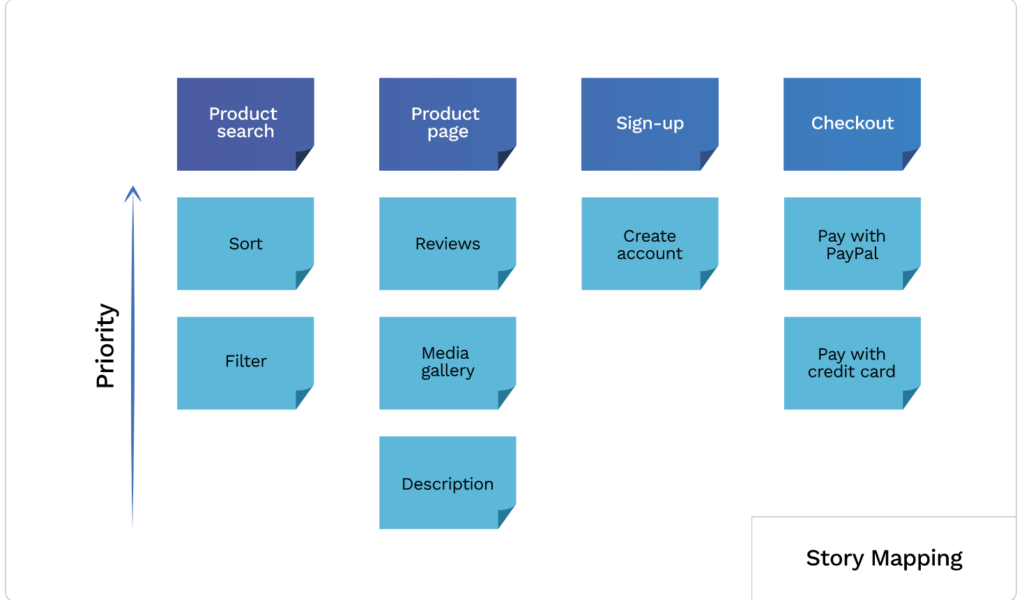
Where do the new features stand in the user journey map? Will any part of the user experience underserved or completely unnoticed in the upcoming release? May that prevent you from fulfilling the objectives for the upcoming stage? Could it backfire?
This final step of The PriX Method for product prioritization for startups and product owners is about putting on the lenses of your users and making one last qualitative assessment before you divide the chosen stories into sprints.
Congrats, you’re all set to push your product another step forward!
Final remarks
In this article, we talked about roadmaps and releases, discussed the importance of prioritization, and taught you our own PriX Method for product prioritization in a step-by-step guide.
The PriX Method is an easy-to-use framework from which your team can greatly benefit when doing product prioritization, whether you are a startup or a company with a more mature digital product.
Nonetheless, mind that similarly to other prioritization tools, The PriX Method has its limitations. If you want to make the most out of it, you should follow these recommendations:
- Plan small releases frequently instead of piling up too many features at once.
- Apply the principles of the Lean approach – build, measure, learn, and repeat!
- Use common sense as a valid tool for the final check of your prioritization output – will this set of features lead to the desired outcome, will it bring the target value to the right group of users?
- If you are not sure about your prioritization process, ask experts for guidance. Our experienced app developers in London will be very happy to help!
If you have questions about The PriX Method, or if you are looking for professional app developers for startups, don’t hesitate to contact us.